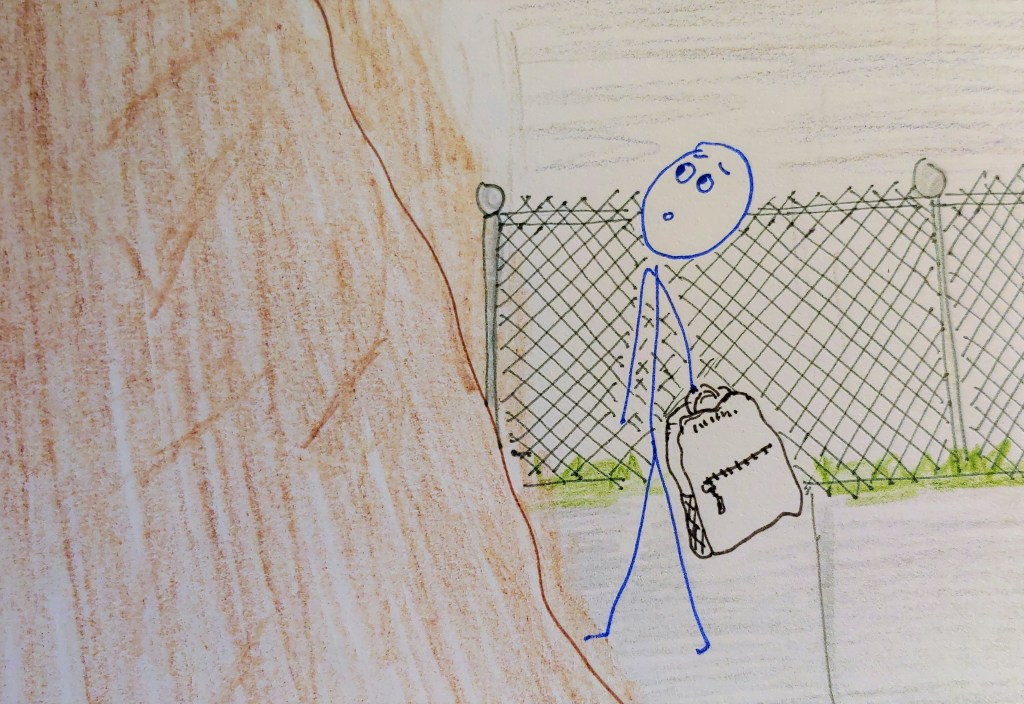
She woke up, not knowing she had been asleep. Watching the trees flying past her window, she heard the soft regular clicks of the turn signal and felt a slight pull to the right as the car changed lanes. Not shifting her gaze, she asked quietly, “You doing okay”?
“I’m fine,” her husband answered.
Reassured, she settled back on the soft, spongy pillow wedged between her seat back and the door frame, lulled back to a dreamy state by the hum of the car tires on the road. It seemed they had been traveling forever on this highway, passing and being passed by impersonal vehicles of all kinds, each rushing to get somewhere. Everyone was alert to the presence of the other vehicles, but no one sought to look past the outside metal structures – to see those who inhabited the inside. She and her husband were no different.
The blank, silver side of a large truck slowly filled her vision as her husband leisurely passed it. Without anything more interesting to watch, she closed her eyes and waited for her window to clear.
Once again, she awoke, surprised that she had fallen asleep so easily. Slowly she opened her eyes. As she watched the scenery march past, confusion slowly replaced her comfortable drowsiness. Something was different. She couldn’t tell what it was, but something had definitely changed.
And then she knew. The landscape was different. Instead of the lush evergreen-filled woods, some of the branches of these trees were bare. There were still some pine trees interspersed between the skeletal trees, but not quite enough to create the deep forests that had surrounded them at the beginning of their journey.
“Where are we?” she asked her husband. “Where did the evergreens go? I don’t think it’s supposed to be like this.”
“Oh, we’ve traveled quite a way since you fell asleep. This is what the landscape looks like now. Don’t worry about it. You might even come to like it.”
“I doubt it. Are you sure we’re going the right way?”
“Sure. This is still the same road the GPS said to take. Until it tells me differently, this is the way I’m going to keep driving. Relax. We’re fine.”
She wasn’t so sure, but took his word for it and went back to staring out the window. She watched as the evergreen trees became even sparser until the entire forest looked dead. And then even the forests thinned out revealing large barren fields of brown grass. This couldn’t be the right way. The directions they had been given had promised to lead them to life, not take them away from it.
Looking back at her husband, she noticed his dreamy expression and languid movements, as if he was daydreaming his way along the highway. Concern spurred her to sit up and cry, “Hey, wake up!”
“I am awake,” he mumbled in response. “Calm down.”
“You don’t look awake. And this definitely doesn’t look like the right way. Where’s your phone? I want to check the navigation system.”
“Oh, I shut it off a long time ago. This road is easy enough to follow. We don’t need it.”
Her heart froze. “Don’t need it? Of course we need it! How do you know that you’re still going in the right direction?”
He shrugged. “I haven’t seen any other roads. Besides, with so many others going this way, it has to be right. I’m just following them.”
She reached for her phone. “I’m going to check anyway.” Quickly she opened the Maps program and entered their destination. She watched as the map zoomed in and out until it settled on the quickest road. She hit ‘Start’ and listened for the directions, but stopped when she heard the word ‘U-turn’. “I knew it! We’re heading in the wrong direction!”
“How could that be?” He drew up his shoulders and let out a noisy breath as he squinted through the windshield. “I’m following the road like I was told to do.”
She held up the phone. “But you quit listening for directions. You missed the narrow side road that we were supposed to take!”
She watched as understanding slowly dawned in his eyes. “Um, maybe I should have stayed more alert.”
She knew he wasn’t the only one to blame. Softly touching her husband’s shoulder, she said, “And I shouldn’t have fallen asleep. We need to turn around. But this time, let’s stay connected to the navigation system.”
~ ~ ~ ~ ~
Moral of the story: Don’t sleep your way through life, following the crowd heading where you don’t want to go. Stay alert and connected to the Navigator who alone will show you the right way to go.
Jesus answered, “I am the way and the truth and the life. No one comes to the Father except through me.” John 14:6
“But small is the gate and narrow the road that leads to life, and only a few find it.” Matthew 7:14
“You have made known to me the paths of life; you will fill me with joy in your presence.” Acts 2:28
“This is why it is said: “Wake up, sleeper, rise from the dead, and Christ will shine on you.” Be very careful, then, how you live – not as unwise but as wise, making the most of every opportunity, because the days are evil. Therefore do not be foolish, but understand what the Lord’s will is. Eph 5:14-17
We all see it. The growing division between those who have been vaccinated and those who haven’t is both heartbreaking and scary. The condemnation, name-calling, and judgment being flung by both sides is horrendous for anyone, but especially for Christians. Aren’t we supposed to act like Christ? Aren’t we supposed to bring light and peace into our society instead of promoting fear and darkness? Or is that what we are trying to do when we point out how ignorant, misinformed, selfish, fearful, brainwashed, careless, and divisive the other side is?
As always, I went to the Bible to see if I could figure out if what we’re doing fits God’s way of doing things. After all, we are His image bearers and are supposed to be revealing His nature to those around us.
God doesn’t use fear tactics – or does He?
Now when all the people saw the thunder and the flashes of lightning and the sound of the trumpet and the mountain smoking, the people were afraid and trembled, and they stood far off and said to Moses, “You speak to us, and we will listen; but do not let God speak to us, lest we die.” Moses said to the people, “Do not fear, for God has come to test you, that the fear of him may be before you, that you may not sin.” The people stood far off, while Moses drew near to the thick darkness where God was. Exodus 20: 18-21 (This happened when the Israelites heard God speaking to Moses, giving him the Ten Commandments.)
God doesn’t create disunity – or does He?
Do not think I have come to bring peace to the earth. I have not come to bring peace, but a sword. For I have come to set a man against his father, a daughter against her mother, and a daughter-in-law against her mother-in-law. Matthew 10:34-35 (This is the same word peace as used in John 14:27 when He said “Peace I leave with you…”)
God doesn’t name-call – or does He?
“Woe to you, scribes and Pharisees, hypocrites! For you build the tombs of the prophets and decorate the monuments of the righteous, saying, ‘If we had lived in the days of our father, we would not have taken part with them in the shedding of the blood of the prophets.’ Thus you witness against yourselves that you are sons of those who murdered the prophets. Fill up, then, the measure of your fathers. You serpents, you brood of vipers, how are you to escape being sentenced to hell? Matthew 23:13:29-33 (Jesus said this to the Pharisees for claiming they wouldn’t have killed the prophets like their forefathers had.)
That was eye-opening to me. Maybe we are doing what we should be doing. But then I took a peek behind the curtain. I looked at the why.
What I discovered was – and this is crucial – EVERYTHING GOD DID AND SAID WAS RELATED TO FOLLOWING HIM AND LIVING IN HIS KINGDOM. He was concerned about the spiritual health of His people. He wanted them in a relationship with Him and used these tactics to warn them away from everything that would harm that relationship, or to point out his enemies who were threatening that relationship.
However, that is NOT what we are doing. What I see and hear in our behavior these days is not about our relationship with God. It’s not about following Jesus, but about following our opinions, our feelings, our rights, our consciences, our leaders, our chosen experts, our understanding, our fear, etc. It’s all about us and how we want to live.
Satan is a counterfeiter. He’s using God’s tactics against us by twisting them to fit his own agenda. He has us killing, hating, lying, deceiving, judging, hurting, segregating, rejecting, and suspecting each other. And I’m not just talking about non-Christians. Although they are engaged in the same behaviors, they have an excuse. We Christians do not. As long as Satan can keep us acting like this, he can effectively shut down our influence in our society.
What do we do?
Put our eyes on Jesus – and keep them there.
Obey Him first.
God knows what’s best for us. For many Christians, getting the vaccine is fine with Him. For many others, it is not. God knows what we don’t. Maybe the vaccine will save the lives of those who are told to receive it, while it will keep those who are told not to get it from a serious adverse effect. I don’t know, and it’s not my place to judge anyone concerning this.
I think if Paul were alive and writing Romans today, he may have included vaccines in the following passage.
As for the one who is weak in faith, welcome him, but not to quarrel over opinions. One person believes he may eat anything, while the weak person eats only vegetables. Let not the one who eats despise the one who abstains, and let not the one who abstains pass judgment on the one who eats, for God has welcomed him. Who are you to pass judgment on the servant of another? It is before his own master that he stands or falls. And he will be upheld, for the Lord is able to make him stand. Romans 14:1-4
Each person needs to pray and discern what God wants them to do and not project what they decide onto other Christians.
One person esteems one day as better than another, while another esteems all days alike. Each one should be fully convinced in his own mind. The one who observes the day, observes it in honor of the Lord. The one who eats, eats in honor of the Lord, since he gives thanks to God, while the one who abstains, abstains in honor of the Lord and gives thanks to God. For none of us live to himself, and none of us dies to himself. For if we live, we live to the Lord, and if we die, we die to the Lord. So then, whether we live or whether we die, we are the Lord’s. Romans 14:5-8
Whether we get the vaccine or not, it’s important that our decision be out of obedience to God, and not out of fear, rebellion, pride, or peer pressure. And we must not shove our decision in the faces of those who decide differently, nor discriminate against them in any way. I think vaccine passports might fit this.
Do not, for the sake of food, destroy the work of God. Everything is indeed clean, but it is wrong for anyone to make another stumble by what he eats. It is good not to eat meat or drink wine or do anything that causes your brother to stumble. The faith that you have, keep between yourself and God. Blessed is the one who has no reason to pass judgment on himself for what he approves. But whoever has doubts is condemned if he eats, because the eating is not from faith. For whatever does not proceed from faith is sin. Romans 14:20-23
Jesus wants us spending our time here on earth serving others, not tearing them down. We need to be working on bringing people closer to God, not participating in things that cause separation. We need to keep our focus on the spiritual and not the earthly.
And those who belong to Christ Jesus have crucified the flesh with its passions and desires. If we live by the Spirit, let us also keep in step with the Spirit. Let us not become conceited, provoking one another, envying one another. Galatians 5:24-26
Instead of bickering, let’s seek ways to serve each other. Let’s reject anything that divides us so that we can be one as Jesus prayed that we would be. Let’s quit unwittingly playing Satan’s game and spend our time doing what Jesus calls us to do.
Let’s be the light of Jesus in these dark, confusing, and broken times.
Some notes:
The words for afraid and fear in Exodus mean just what they say. I’ve heard people try to explain them away (God loves us so we’re not supposed to be afraid of Him.) But the original words make it clear that yes, if it serves to keep our relationship with God right, we might need to remember just how fearfully powerful He is.
In Exodus
be afraid,” תִּירָאוּ֒ (tî·rā·’ū) Verb – Qal – Imperfect – second person masculine plural Strong’s 3372: To fear, to revere, caus, to frighten
the fear of Him יִרְאָת֛וֹ (yir·’ā·ṯōw) Noun – feminine singular construct | third person masculine singular Strong’s 3374: Fear, reverence
The original word for peace used in Matthew 10:34-35 is the same one used here in John 14:27. Without doing a lengthy bible study on these verses, I would say that Jesus is talking about an inner peace and an outer peace. He gave us His inner peace, one that we will have no matter what happens around us. However, choosing Jesus over everything else threatens the peace of family relationships if not everyone is a disciple. Jesus didn’t come so that above all we would live in peace. He came so that above all people would be reconnected with the Father through Him. Turning to Jesus frequently results in ostracization, accusations, rejection, and condemnation by family members who don’t understand the change and feel threatened by it. I would add that obeying Jesus may have the same results at times.
peace εἰρήνην (eirēnēn) Noun – Accusative Feminine Singular Strong’s 1515: Probably from a primary verb eiro; peace; by implication, prosperity.
Here’s Matthew 10:34-35 in context. Jesus is talking to His twelve disciples just before He sends them out to preach and heal.
“Behold, I am sending you out as sheep in the midst of wolves, so be wise as serpents and innocent as doves. Beware of men, for they will deliver you over to courts and flog you in their synagogues, and you will be dragged before governors and kings for my sake, to bear witness before them and the Gentiles. When they deliver you over, do not be anxious how you are to speak or what you are to say, for what you are to say will be given to you in that hour. For it is not you who speak, but the Spirit of your Father speaking through you. Brother will deliver brother over to death, and the father his child, and children will rise against their parents and have them put to death, and you will be hated by al for my name’s sake. But the one who endures to the end will be saved. When they persecute you in one town, flee to the next, for truly, I say to you, you will not have gone through all the towns of Israel before the Son of Man comes. A disciple is not above his teacher, nor a servant above his master. It is enough for the disciple to be like his teacher, and the servant like his master. If they have called the master of the house Beelzebul, how much more will they malign those of his household. So have not fear of them, for nothing is covered that will not be revealed, or hidden that will not be known. What I tell you in the dark, say in the light, and what you hear whispered, proclaim on the housetops. And do not fear those who kill the body but cannot kill the soul. Rather fear him who can destroy both soul and body in hell. Are not two sparrows sold for a penny? And not one of them will fall to the ground apart from your Father. But even the hairs on your head are numbered. Fear not, therefore; you are of more value than many sparrows. So everyone who acknowledges me before men, I also will acknowledge before my Father who is in heaven, but whoever denies me before me, I also will deny before My Father who is in heaven. Do not think I have come to bring peace to the earth. I have not come to bring peace, but a sword. For I have come to set a man against his father, and a daughter against her mother, and a daughter-in-law against her mother-in-law. And a person’s enemies will be those of his own household. Whoever loves father or mother more than me is not worthy of me, and whoever loves son or daughter more than me is not worthy of me. And whoever does not take his cross and follow me is not worthy of me. Whoever finds his life will lose it, and whoever loses his life for my sake will find it. Matthew 10:16-39
“Enter by the narrow gate. For the gate is wide and the way is easy that leads to destruction, and those who enter by it are many. For the gate is narrow and the way is hard that leads to life, and those who find it are few. (Matthew 7:13-14)
To be God’s friend, and not His enemy, (see previous blogs) we need to obey Him. Obedience is not easy. It comes with a cost that affects us and often the people around us. It’s a serious decision, one with huge impacts and grave consequences. It’s a decision that we have to consciously make.
Jesus said to consider the cost to being His disciple.
It cost Noah a career change, at least temporarily. The Bible is not clear what Noah did before he built the ark, but it most likely wasn’t large-scale construction or wild animal care.
It cost Abraham his homeland. He had to leave his father and most people he knew to go where he knew not. I doubt any of them understood why Abraham was leaving them, especially if every question they asked was answered with, “I don’t know. God just said to go.”
It cost Moses his comfort zone to have to speak to the pharaoh, and the initial impact of his obedience resulted in harder living conditions for the Israelites.
It cost Esther her safety as she faced death for breaking the king’s law.
It cost David his lifestyle. He went from a quiet, peaceful life as a shepherd to a dangerous, stressful life as a king.
It cost Jeremiah his freedom. When leaders didn’t like his prophecies, they sometimes locked him up or threw him into a well.
It cost the wise men their time as they went in search of the Child. The Bible doesn’t say, but their families may have been left behind on a journey that may have taken at least four years. If so, I doubt their wives or children were very happy about it.
It cost Mary and Joseph stability in the early years of their marriage as they had to keep moving from one place to another in order to keep their new baby safe. I can imagine what their friends might have said: “You’re moving again, because of a dream?”
It cost Paul his pride. He gave up everything he was proud of – his zeal, training, knowledge, status – to become a servant of Christ.
It cost numerous Believers their family, friends, and even lives. Imagine the attitude of the unbelievers in their lives (both family and friends) as the Believers chose the new cultish belief over everything else.
Obedience requires knowing who to obey. These people in the Bible all obeyed God, which frequently put them at odds with societal and religious norms. We need to do the same. Jesus didn’t say to follow the church or church leaders. He didn’t say to follow society. He didn’t say to follow the government or other organizations. He said to follow Him. He sent us His Holy Spirit to ensure we could hear Him, and He gives us His grace to empower us to respond obediently.
We may not think God is calling us to do something but He is. He has a job for us, a mission to accomplish, a stand to take, or a light to shine. We may not like it. We may be in denial. We may question it. We may procrastinate. We may talk ourselves out of it. We may twist it to fit what we want to do or believe. But none of that excuses us from obeying Him. His mercy allows us time to grapple with what He wants us to do, but eventually we must decide to obey or disobey. There are no other choices.
“If anyone comes to me and does not hate his own father and mother and wife and children and brothers and sisters, yes, even his own life, he cannot be my disciple. Whoever does not bear his own cross and come after me cannot be my disciple. For which of you, desiring to build a tower, does not first sit down and count the cost, whether he has enough to complete it?… So therefore, any one of you who does not renounce all that he has cannot be my disciple. (Luke 14:26-28, 33)
Then Jesus told his disciples, “If anyone would come after me, let him deny himself and take up the cross and follow me. For whoever would save his life will lose it, but whoever loses his life for my sake will find it. For what will it profit a man if he gains the whole world and forfeits his soul? Or what shall a man give in return for his soul? (Matthew 16:24-26)
“Enter by the narrow gate. For the gate is wide and the way is easy that leads to destruction, and those who enter by it are many. For the gate is narrow and the way is hard that leads to life, and those who find it are few. (Matthew 7:13-14)
Noah began to be a man of the soil, and he planted a vineyard. (Genesis 9:20 ESV) or Noah, a man of the soil, was the first to plant a vineyard. (Genesis 9:20 HCSB)
Now the LORD said to Abram, “Go from our country and from your kindred and your father’s house to the land I will show you. (Genesis 12:1)
“Come, I will send you to Pharaoh that you may bring my people, the children of Israel out of Egypt.” But Moses said to God, “Who am I that I should go to Pharaoh and bring the children of Israel out of Egypt?” (Ex 3:10) Then Moses answered, “But behold, they will not believe me or listen to my voice, for they will say, ‘the LORD did not appear to you.’” (Ex 4:4) But Moses said to the LORD, “Oh, my Lord, I am not eloquent, either in the past or since you have spoken to your servant, but I am slow of speech and tongue.” (Ex 4:10)
Afterward Moses and Aaron went and said to Pharaoh, “Thus says the Lord, the God of Israel, ‘Let my people go, that they may hold a feast to me in the wilderness.’” But Pharaoh said, “Who is the Lord, that I should obey his voice and let Israel go? I do not know the Lord, and moreover, I will not let Israel go.” Then they said, “The God of the Hebrews has met with us. Please let us go a three days’ journey into the wilderness that we may sacrifice to the Lord our God, lest he fall upon us with pestilence or with the sword.”But the king of Egypt said to them, “Moses and Aaron, why do you take the people away from their work? Get back to your burdens.”And Pharaoh said, “Behold, the people of the land are now many,and you make them rest from their burdens!” The same day Pharaoh commanded the taskmasters of the people and their foremen, “You shall no longer give the people straw to make bricks, as in the past; let them go and gather straw for themselves. But the number of bricks that they made in the past you shall impose on them, you shall by no means reduce it, for they are idle. Therefore they cry, ‘Let us go and offer sacrifice to our God.’ Let heavier work be laid on the men that they may labor at it and pay no regard to lying words.” So the taskmasters and the foremen of the people went out and said to the people, “Thus says Pharaoh, ‘I will not give you straw. Go and get your straw yourselves wherever you can find it, but your work will not be reduced in the least.’” So the people were scattered throughout all the land of Egypt to gather stubble for straw. The taskmasters were urgent, saying, “Complete your work, your daily task each day, as when there was straw.” And the foremen of the people of Israel, whom Pharaoh’s taskmasters had set over them, were beaten and were asked, “Why have you not done all your task of making bricks today and yesterday, as in the past?” Then the foremen of the people of Israel came and cried to Pharaoh, “Why do you treat your servants like this? No straw is given to your servants, yet they say to us, ‘Make bricks!’ And behold, your servants are beaten; but the fault is in your own people.” But he said, “You are idle, you are idle; that is why you say, ‘Let us go and sacrifice to the Lord.’ Go now and work. No straw will be given you, but you must still deliver the same number of bricks.”The foremen of the people of Israel saw that they were in trouble when they said, “You shall by no means reduce your number of bricks, your daily task each day.” They met Moses and Aaron, who were waiting for them, as they came out from Pharaoh; and they said to them, “The Lord look on you and judge, because you have made us stink in the sight of Pharaoh and his servants, and have put a sword in their hand to kill us.” Then Moses turned to the Lord and said, “O Lord, why have you done evil to this people? Why did you ever send me? For since I came to Pharaoh to speak in your name, he has done evil to this people, and you have not delivered your people at all.” (Exodus 5:1-23)
So they took Jeremiah and cast him into the cistern of Malchiah, the king’s son, which was in the court of the guard, letting Jeremiah down by ropes. And there was no water in the cistern, but only mud, and Jeremiah sank in the mud. (Jeremiah 38:6)
“Go, gather all the Jews to be found in Susa, and hold a fast on my behalf, and do not eat or drink for three days, night or day. I and my young women will also fast as you do. Then I will go to the king, though it is against the law, and if I perish, I perish. (Esther 4:16)
Now after Jesus was born in Bethlehem of Judea in the days of Herod the king, behold, wise men from the east came to Jerusalem, saying, “Where is he who has been born king of the Jews? For we saw his star when it rose and have come to worship him.” When Herod the king heard this, he was troubled, and all Jerusalem with him; and assembling all the chief priests and scribes of the people, he inquired of them where the Christ was to be born. They told him, “In Bethlehem of Judea, for so it is written by the prophet: “’And you, O Bethlehem, in the land of Judah, are by no means least among the rulers of Judah; for from you shall come a ruler who will shepherd my people Israel.’” Then Herod summoned the wise men secretly and ascertained from them what time the star had appeared. (Matthew 2:1-7)
Now when they had departed, behold, an angel of the Lord appeared to Joseph in a dream and said, “Rise, take the child and his mother, and flee to Egypt, and remain there until I tell you, for Herod is about to search for the child, to destroy him.” And he rose and he took the child and his mother by night and departed to Egypt and remained there until the death of Herod. (Matthew 2:13-15a)
Then Herod, when he saw that he had been tricked by the wise men, became furious, and he sent and killed all the male children in Bethlehem in all that region who were two years old or under, according to the time that he had ascertained from the wise men. (Matthew 2:16)
But when Herod died, behold, an angel of the Lord appeared in a dream to Joseph in Egypt, saying, “Rise, take the child and his mother and go to the land of Israel, for those who sought the child’s life are dead.” And he rose and took the child and his mother and went to the land of Israel. But when he heard that Archelaus was reigning over Judea in place of his father Herod, he was afraid to go there, and being warned in a dream he withdrew to the district of Galilee. And he went and lived in a city called Nazareth… (Matthew 2:19-23a)
For we are the circumcision, who worship by the Spirit of God and glory in Christ Jesus and put no confidence in the flesh – though I myself have reason for confidence in the flesh also. If anyone else thinks he has reason for confidence in the flesh, I have more: circumcised on the eighth day, of the people of Israel, of the tribe of Benjamin, a Hebrew of Hebrews; as to the law, a Pharisee; as to zeal, a persecutor of the church; as to righteousness under the law, blameless. But whatever gain I had, I counted as loss for the sake of Christ (Philippians 3:3-7)
For if we live, we live to the Lord, and if we die, we die to the Lord. So then, whether we live or whether we die, we are the Lord’s. (Romans 14:8)
After all, I go to church regularly, tithe consistently, give of my time generously, read the Bible daily, and say my prayers faithfully. I am nice to people and work hard to take care of my family. I believe in Jesus, accepted Him as my Savior, and am baptized. I follow the Ten Commandments the best I can.
There’s no way God and I are enemies!
Are you sure? James 4:4 says, “You adulterous people! Do you not know that friendship with the world is enmity with God? Therefore whoever wishes to be a friend of the world makes himself an enemy of God.”
You can’t be friends with both God and the world because you can’t live by both God’s ways and the world’s ways.
The world says everyone can find their own way to God, and that each way is as valid as the others. God says Jesus is the only way. Acts 4:11-13
The world says everyone is a child of God. God says we become His children when we accept Jesus. John 1:12
The world says it’s okay to do whatever makes us happy. God says not to let sin reign in our bodies, making us obey its passions. Romans 6:12
The world says everyone should choose their own gender and sexual orientation. God says there are only two genders – male and female – and that appropriate sex is only between a man and his wife. Genesis 1:27
The world says name-calling, ridiculing, lying , cancelling, violent protests, retaliation, and discrimination is okay when done to those who disagree with them. God says to love our enemies, to do good to those who hate us, and to pray for those who persecute us. Matthew 5:43-45a; Luke 6:27
Your behavior, attitudes, beliefs, mindsets, actions, and reactions reveal whose side you have chosen. Have you compromised, rationalized, justified, and given in to the world in order to fit in or to have an easier, more comfortable life? Do you go along with whatever the world says to avoid being insulted, hated, ostracized, criticized, or misunderstood? Do you allow or ignore wrongdoing instead of standing up for what is right?
If so, you are propagating the enemy’s agenda instead of God’s agenda and spreading the darkness of the evil one instead of reflecting the glory of God. You are not only in the world, but have chosen to be part of it.
And that makes you God’s enemy.
If the world hates you, know that it has hated me before it hated you. If you were of the world, the world would love you as its own; but because you are not of the world, but I chose you out of the world, therefore the world hates you. John 15:18-19
This Jesus is the stone that was rejected by you, the builders, which has become the cornerstone. And there is salvation in no one else, for there is no other name under heaven given among men by which we must be saved.” Acts 4:11-13
Let not sin therefore reign in your mortal body, to make you obey its passions. Romans 6:12
So God created man in his own image, in the image of God he created him; male and female he created them. Genesis 1:27
But to all who did receive him, who believed in his name, he gave the right to become children of God, John 1:12
By this it is evident who are the children of God, and who are the children of the devil: whoever does not practice righteousness is not of God, nor is the one who does not love his brother. 1 John 3:10
And you were dead in the trespasses and sins in which you once walked, following the course of this world, following the prince of the power of the air, the spirit that is now at work in the sons of disobedience – among whom we all once lived in the passions of our flesh, carrying out the desires of the body and the mind, and were by nature children of wrath, like the rest of mankind. Eph 2:2-3
“You have heard that is was said, ‘You shall love your neighbor and hate your enemy.’ But I say to you, love your enemies and pray for those who persecute you, so that you may be sons of your Father who is in heaven. Matthew 5:43-45a
“But I say to you who hear, love your enemies, do good to those who hate you, Luke 6:27
“Blessed are you when people hate you and when they exclude you and revile you and spurn your name as evil, on account of the Son of Man! Luke 6:22
I’ve heard it ever since I became a Christian. I’ve even said it myself.
But is it true? Is God your friend?
God’s friends believe in Jesus, but believing in Jesus doesn’t make you His friend. Just ask a demon. (On second thought, don’t.)
God’s friends go to church, but going to church doesn’t make you His friend. There are plenty of church-goers who aren’t even Believers.
God’s friends live their lives doing good, but doing good doesn’t make you His friend. Lots of people spend their lives doing good in a great number of ways – including witches and New Age followers.
God’s friends give generously, but giving generously doesn’t make you His friend. Some atheists are extremely generous.
God’s friends follow church rules, but following church rules doesn’t make you His friend. Not even following the Ten Commandments makes you His friend. In the New Testament, Paul had a lot to say about living by the Law, and it wasn’t good.
God’s friends read the Bible, but reading the Bible doesn’t make you His friend. Some people search it for ways to debunk Christians.
God’s friends love Him, but loving God doesn’t make you His friend. People love celebrities (think Elvis), but that doesn’t make them friends.
So what does make you His friend?
Jesus answered that in John 15:14 “You are My friends if you do what I command you.”
He didn’t say…
You are My friends if you do what the world commands.
You are My friends if you do what religious leaders command.
You are My friends if you do what your heart commands.
He said, “You are My friends if you do what I command.”
Obedience to what God says. Jesus said a lot in the New Testament about how He wants us to live. And He continues today to tell us what He wants us to do, usually through the prompting of the Holy Spirit. He speaks to us through the Bible (and other books), through other people (both Christians and non-Christians), through circumstances (both good and bad), and through a quiet voice we can sense in our hearts. He is not limited on how He speaks to us. The methods He chooses are not all the same, but no matter how He speaks, His voice is recognized by His people.
But what if we can’t hear Him? Jesus said we would know His voice. If we don’t, maybe we aren’t really His friend. Maybe we’re living our lives for ourselves. Maybe we’re allowing Him in some places in our lives, but not in others. Maybe we pick and choose which of His commands we follow. Maybe we don’t care enough to pay the cost of His friendship; instead we take His grace for granted. Maybe we don’t know that He can and wants to be our friend.
Is God your friend? I hope so. If not, He’s not the one holding back.
John 10:27-28 My sheep hear my voice, and I know them, and they follow me. I give them eternal life, and they will never perish, and no one will snatch them out of my hand.
John 14:21 Whoever has my commandments and keeps them, he it is who loves me. And he who loves me will be loved by my Father, and I will love him and manifest myself to him.”
The water looks so inviting. The colors are amazing, and on a hot day, the thought of how refreshing it will feel is almost more than I can resist.
And yet, I know to stay out of it.
I know danger lurks beneath its dazzling emerald invitation even though I can’t see it.
I know… because the flags tell me.
Yellow is a warning to be careful, and purple warns of dangerous marine life in the water.
I could still go in, but that wouldn’t be good for me. I might even be fine for a while, but sooner or later I will get stung by a jellyfish, punctured by a stingray, or bitten by a sea snake.
The danger is real whether I can see it from where I stand or not.
Knowing of the danger, I have a choice. I can continue to stare at the water, imagining the pleasure of soaking in its coolness, splashing in the waves, and floating up and down on the swells, thus making myself sad or angry – or worse, talking myself into going in anyway,
or I can choose to focus on the refreshing cool breeze as I hunt shells or build sand structures.
It reminds me of life, and how God has warned us to stay out of places that could turn around and bite us. He doesn’t tell us not to swim in order to make our day miserable. He tells us to keep us safe.
In His Word, He has warned us to stay away from sexual immorality, idolatry, adultery, homosexuality, stealing, greed, drunkenness, reviling, swindling, devotion to mythology and genealogies, enslaving, lying, perjury, impurity, sensuality, sorcery, enmity, strife, jealousy, fits of anger, rivalries, dissensions, divisions, envy, malice, deceit, hypocrisy, slander, orgies, and things like these (1 Cor 6:8-10; 1 Tim 1:3-10; Gal 5:19-21; 1 Peter 2:1).
I could focus on that list, imagining how good they would make me feel, how I have the right to respond in those ways when others mistreat me, and how some aren’t really that bad, thus making myself sad or angry – or worse, reasoning my way or letting others talk me into participating in them anyway,
or I can choose to focus on my relationship with God as I look for ways to spread His love to others.
Everything on that list involves putting self ahead of God and ahead of other people, which is opposite of what Jesus said.
Jesus gave us only two commands: Love God above all, and love others as He loves us. (Luke 10:27). If we put God and His ways above everything else – seeking His kingdom first (Matt 6:33) – and if we seek the good of others before our own good (Philippians 2:3-4) – we won’t be doing anything on that list. We won’t have time for anything on that list. We won’t even have to memorize that list, or any other list that can be found in the Bible.
Those who follow Jesus’ two commandments don’t even need that list.
Let’s be what Jesus has called us to be – His disciples. Let’s adopt the same mindset of Jesus (Phillipians 2:5-8).
Let’s not get bit.
Philippians 2:3-8 Do nothing from selfish ambition or conceit, but in humility count others more significant than yourselves. Let each of you look not only to his own interests, but also to the interests of others. Have this mind among you, which is yours in Christ Jesus, who, though he was in the form of God, did not count equality with God a thing to be grasped, but emptied himself, by taking the form of a servant, being born in the likeness of men. And being found in human form, he humbled himself by becoming obedient to the point of death, even death on a cross.
1 Tim 1:3-11 As I urged you when I was going to Macedonia, remain in Ephesus so that you may charge certain persons not to teach any different doctrine, nor to devote themselves to myths and endless genealogies, which promote speculations rather than the stewardship from God that is by faith. The aim of our charge is love that issues from a pure heart and a good conscience and a sincere faith. Certain persons, by swerving from these, have wondered away into vain discussions, desiring to be teachers of the law, without understanding either what they are saying or the things about which they make confident assertions. Now we know the law is good, if one uses it lawfully, understanding this, that the law is not laid down for the just but for the lawless and disobedient, for the ungodly and sinners, for the unholy and profane, for those who strike their fathers and mothers, for murderers, the sexually immoral, men who practice homosexuality, enslavers, liars, perjurers, and whatever else is contrary to sound doctrine, in accordance with the gospel of the glory of the blessed God with whom I have been entrusted.
Galatians 5:16-24 But I say, walk by the Spirit, and you will not gratify the desires of the flesh. For the desires of the flesh are against the Spirit and the desires of the Spirit are against the flesh, for these are opposed to each other, to keep you from doing the things you want to do. But if you are led by the Spirit, you are not under the law. Now the works of the flesh are evident: sexual immorality, impurity, sensuality, idolatry, sorcery, enmity, strife, jealousy, fits of anger, rivalries, dissensions, divisions, envy, drunkenness, orgies, and things like these. I warn you, as I warned you before, that those who do such things will not inherit the kingdom of God. But the fruit of the Spirit is love, joy, peace, patience, kindness, goodness, faithfulness, gentleness, self-control; against such things there is no law. And those who belong to Christ Jesus have crucified the flesh with its passions and desires.
1 Cor 6:12-20 “All things are lawful for me,” but not all things are helpful. “All things are lawful to me,” but I will not be dominated by anything. “Food is meant for the stomach and the stomach for food” – and God will destroy both one and the other. The body is not meant for sexual immorality, but for the Lord, and the Lord for the body. And God raised the Lord and will also raise us up by this power. Do you not know that your bodies are members of Christ? Shall I then take the members of Christ and make them members of a prostitute? Never! Or do you not know that he who is joined to a prostitute becomes one body with her? For as it is written, “The two will become one flesh.” But he who is joined to the Lord becomes one spirit with him. Flee from sexual immorality. Every other sin a person commits is outside the body, but the sexually immoral person sins against his own body. Or do you know know your body is a temple of the Holy Spirit within you, whom you have from God? You are not your own, for you were bought with a price. So glorify God in your body.
Galatians 5:14 For the whole law is fulfilled in one word: “You shall love your neighbor as yourself.”
Luke 10:27 And he answered, “You shall love the Lord your God with all your heart and with all your soul and with all your strength and with all your mind, and your neighbor as yourself.”
John 15:12 “This is my commandment, that you love one another as I have loved you.
I’ve been hearing a lot about unity from the White House over the last month. I thought I knew what that was, but, based on what I’ve seen lately, I started thinking maybe my definition of unity was flawed. So I looked it up.
According to an online dictionary, unity can mean 1. the absence of diversity, of having unvaried or uniform character; 2. oneness as in combining all parts into one whole; or 3. oneness of mind and feeling among people where they live in harmony or agreement.
I wasn’t surprised with definitions #2 and #3 because that’s how I understood unity – people living in harmony together, agreeing to disagree when viewpoints differed, but ultimately accepting each other as valued parts of a whole. Unity like this can be likened to a large salad – each ingredient remaining identifiable, yet together creating a marvelous meal.
What I didn’t expect to see was definition #1. Absence of diversity? Unvaried or uniform character? That would be like cake batter in which most ingredients lose their individual identity when combined, disappearing in the uniform mixture they create. What would this kind of unity look like in this country? Who decides what that unvaried or uniform character would be? As I think about the increasing suppression of conservative viewpoints and intolerance of Christian beliefs that’s been happening in our country, and all the more since the election, the more alarming this has become to me. When the democrats speak of unity, is this the definition they’re using? Is this what Biden means when he keeps talking about unity? That would explain a lot concerning his actions and the direction this country is going.
I think I know what conservatives believe about unity.
I am beginning to understand what liberals may mean by unity.
But what does God say about unity? Which of the three definitions above does God mean? Or does He have His own definition? I did a search for the word unity on a Bible app and only came up with a handful of scriptures. Looking at the original Greek or Hebrew words didn’t help answer my question this time. Different words were used, and each definition could be interpreted in several ways, which is illustrated in different Bible translations.
Ps. 133:1 A Song of Ascents. Of David. Behold, how good and pleasant it is when brothers dwell in unity! (ESV)
Ps. 133:1 A Davidic song of ascents. How good and pleasant it is when brothers live together in harmony! (HCSB)
Col 3:14 Above all, put on love – the perfect bond of unity.
of perfect unity. τελειότητος (teleiotētos) Noun – Genitive Feminine Singular Strong’s Greek 5047: Perfectness, perfection, maturity. From teleios; completeness.
Eph 4:1-3 I therefore, a prisoner for the Lord, urge you to walk in a manner worthy of the calling to which you have been called, with all humility and gentleness, with patience, bearing with one another in love, eager to maintain the unity of the Spirit in the bond of peace.
Eph 4:13 …till we all come to the unity of the faith…
unity ἑνότητα (henotēta) Noun – Accusative Feminine Singular Strong’s Greek 1775: Oneness, unity, unanimity. From heis; oneness, i.e. unanimity.
1 Pet 3:8 Finally, all of you, have unity of mind, sympathy, brotherly love, a tender heart, and a humble mind. (ESV)
1 Pet 3:8 Finally, all of you, be like-minded and sympathetic, love as brothers, be tenderhearted and humble.
[be] like-minded ὁμόφρονες (homophrones) Adjective – Nominative Masculine Plural Strong’s Greek 3675: Of one mind (intent, purpose), like-minded. From the base of homou and phren; like-minded, i.e. Harmonious.
Are we, then, supposed to choose our own definition of unity? Knowing God like I do, I don’t think He would leave us in the dark in an area that is clearly important in how we are to live. And I was right. I found a whole chapter describing unity.
1 Cor 12:1-30 (NKJ) Spiritual Gifts: Unity in Diversity
Now concerning spiritual gifts, brethren, I do not want you to be ignorant: you know that you were Gentiles, carried away to these dumb idols, however you were led. Therefore I make it known to you that no one speaking by the Spirit of God calls Jesus accursed, and no one can say that Jesus is Lord except by the Holy Spirit. There are diversities of gifts, but the same Spirit. There are differences of ministries, but the same Lord. And there are diversities of activities, but it is the same God who works all in all. But the manifestation of the Spirit is given to each one for the profit of all: for to one is given the word of wisdom through the Spirit, to another the word of knowledge through the same Spirit, to another faith by the same Spirit, to another gifts of healings by the same Spirit, to another the working of miracles, to another prophecy, to another discerning of spirits, to another different kinds of tongues, to another the interpretation of tongues. But one and the same Spirit works all these things, distributing to each one individually as He wills. For as the body is one and has many members, but all the members of that one body, being many, are one body, so also is Christ. For by one Spirit we were all baptized into one body – whether Jews or Greeks, whether slaves or free – and have all been made to drink into one Spirit. For in fact the body is not one member but many. If the foot should say, “Because I am not a hand, I am not of the body,” is it therefore not of the body? And if the ear should say, “Because I am not an eye, I am not of the body,” is it therefore not of the body? If the whole body were an eye, where would be the hearing? If the whole were hearing, where would be the smelling? But now God has set the members, each one of them, in the body just as He pleased. And if they were all one member, where would the body be? But now indeed there are many members, yet one body. And the eye cannot say to the hand, “I have no need of you”; nor again the head to the feet, “I have no need of you.” No, much rather, those members of the body which seem to be weaker are necessary. And those members of the body which we think to be less honorable, on these we bestow greater honor; and our unpresentable parts have greater modesty, but our presentable parts have no need. But God composed the body, having given the greater honor to the part which lacks it, that there should be no schism in the body, but that the members should have the same care for one another. And if one member suffers, all the members suffer with it; or if one member is honored, all the members rejoice with it. Now you are the body of Christ, and members individually. And God has appointed these in the church: first apostles, second prophets, third teachers, after that miracles, then gifts of healings, helps, administrations, varieties of tongues. Are all apostles? Are all prophets? Are all teachers? Are all workers of miracles? Do all have gifts of healings? Do all speak with tongues? Do all interpret? But earnestly desire the best gifts. And yet I show you a more excellent way.
Unity, therefore, is both oneness and diversity. We acknowledge our differences, not hide, remove, suppress, or attack them. We find the value in each other, and work together as a whole.
This can be applied to our country also. In order to be a strong, whole, functioning, and healthy nation, we have need for everyone – conservatives and liberals, republicans and democrats.
We need each other’s strengths, ideas, and contributions.
We need both ears in order to hear clearly, or what we hear will be distorted.
We need both eyes in order to see clearly, or we lose our depth perception. We also have blind spots that only the other side can see.
We need all body parts doing what only they can do in order to be a fully functioning body.
Let’s listen to each other – really listen and not let out biases color what we hear. Let’s seek to find value in each other. Let’s work together to understand rather than condemn. Let’s pray for each other, holding each other up instead of tearing each other down.
Then, and only then, will America be the great nation we all want.
Behold, how good and pleasant it is when brothers dwell in unity! (Ps. 133:1 A Song of Ascents. Of David.)
Sheila contemplated the coin in her hand. The little golden disc, not worth much in the world, was worth something to her. The thrill of spotting its glint in the gutter a few minutes ago as she made her way down the sidewalk still bubbled within her. She had seen pennies before, but there was something different about this one. Somehow she felt a great value connected to it that differentiated it from the myriads of others readily available. Not understanding what that value was but knowing she would not be spending this one, she tucked it carefully in her jacket’s inner pocket – the one closest to her heart – and continued her journey.
Several weeks later, Sheila again contemplated, but this time it was water which captured her attention. Not the beautiful water that surrounded her, but the murky water that covered the bottom of her small boat.
She could feel the gentle rock as small waves lapped at the sides of her boat, none of which were big enough to splash over those sides. The water had not come from there. She glanced at her water jug – nope, it had not spilled. Had the water been there when she entered the boat, leftover from the previous day’s rain? No, she would surely have noticed the touch of icy water sloshing over her toes. Too much water would sink her boat but, thankfully, it wasn’t near deep enough for that. Maybe she should ignore it and just enjoy her time on the lake. She picked up her oars but stopped when she felt cold water cover her foot. Alarm bells rang in her mind as panic rose in her heart. The water level was increasing. It had to be a leak. But how? She hadn’t run into anything. At least nothing she knew of. And she hadn’t dropped anything heavy enough to cause damage. No weak areas had been found during its maintenance check last… last… Sheila had been so busy with life, she couldn’t remember the last time she had had the boat serviced. She had been told how important it was to maintain her boat. Her safety, maybe even her life, depended on it. Now she was paying the price for her neglect.
Heart racing, Sheila calculated the rate the boat was filling against the distance back to the dock. If she rowed fast enough, pushing the oars in deep enough, could she might make back in time to hoist it up before it sank? No, rowing that fast and hard would require more strength than she had. She would have to stop the leak now, before heading back. First, she had to find the source of the leak. Hopefully it was small enough to plug it with something, although she had no idea what. Sheila ran her finger along the bottom of the boat. Even after several minutes, she couldn’t feel anything that could signify a leak. Now what?
Slowly, a video she had recently watched came to her mind. In it, someone had described how the movement of the water under the boat can sometimes reveal the spot where the water was entering. Sheila cringed. That would require jumping into that ice cold water without a wet suit. Desperate now, she felt along the bottom of the boat again, this time for the force of water shooting into her boat, not matter how slight. And again she couldn’t find the source of the leak. Not having any other choice, she accepted the inevitable. She was going to have to go in.
Sheila pulled off her jeans and slid on a pair of soccer shorts. The touch of the chilly air on her legs convinced her to wait until the last minute before removing her jacket. According to the video, the movement of the water could be tracked as the tiny bubbles in it reflected the light from a flashlight. Sheila had a waterproof flashlight in her backpack, which she realized, was now in two inches of water. As she bent to pick up the bag, she heard a plop. Her penny! She had forgotten that it was still in her jacket pocket and now it was down in that dark murky water. For a third time she felt along the bottom, this time searching for the small coin, and rejoiced when her fingers found it. Carefully she tucked it into the zippered pocket of her shorts, dug out her flashlight, removed her jacket, and, bracing herself, jumped overboard.
The shock of the cold water was worse than she expected. Gasping, she shivered while treading water, waiting for her body to adjust. As soon as it did, she took a deep breath and dove under the boat. She expected the water to be somewhat clear since the surface was so pretty, but instead it was dark and murky, just like the water filling her boat. Her flashlight revealed multitudes of bubbles moving in all directions. Those were not the bubbles the man in the video had said to focus on. The important ones were the ones closest to her boat. She aimed her flashlight at the bottom of the boat and watched the direction the bubbles were heading. Her lungs began to complain, but she continued studying until one area of bubbles acted differently than the rest. Noting its location, she swam out from under the boat, broke through the surface of the water, took a few deep breaths, and then dove back down. Close examination of the area showed several tiny streams of water heading toward a central location. That had to be where the hole was. Sheila ran her finger across the bottom, and sure enough, felt the indentation of a hole a little more than half an inch across. Although it seemed small, Sheila knew a hole that big would have sunk the boat already. Why hadn’t it? Confused, Sheila poked her little finger in the hole and felt it narrow the deeper she pushed her finger. Ah, that’s why her boat hadn’t sunk yet. The other end of the hole must still be very tiny.
With lungs screaming, Sheila surfaced and refilled her lungs. As she tread water, she mentally took inventory of her supplies. What did she have that could plug the hole that would last long enough for her to get to the dock? Her rag was too big, and she hadn’t worn socks. None of her tools would work. She needed something small and round and waterproof, like a marble, which she could jam into the hole. Water pressure under the boat would hold it in place until she was able to get it repaired properly. At least that’s what the video had said. But she didn’t have a marble. The few nails and screws in the toolbox didn’t have heads big enough. Tissue paper wouldn’t last long enough. And she didn’t have any chewing gum.
And then she had it. Her coin! It was small and round and the perfect size. Carefully, she removed the penny from her pocket and swam back under the boat. Holding the flashlight in her mouth, she felt for the hole with one hand, and, finding it, shoved the coin into the hole with her other hand. She wiggled the penny with her finger, wedging it deeper and deeper into the hole until she couldn’t move it anymore. Slowly she lessened the pressure of her finger and was relieved when water pressure continued to hold the coin in place. Quickly now, Sheila returned to the surface of the water and took several deep gulps of air before climbing back into her boat.
Replacing her wet clothes with the dry jeans and jacket, she wrapped her arms around her body and waited until her body quit shivering. While she waited, she looked at the almost three inches of water that had made its way inside her boat. She should try to scoop it out, but all she had was her water bottle which would take too long. She chastised herself again for being unprepared and decided to get back to the dock as soon as possible. She knew someone trained in the repair of boats that would be able to remove the water and filth much more efficiently than she could.
As she rowed, she thought about the deceptive beauty of the water. On the surface, it was shiny and inviting, but she had learned the hard way how dark and cold the water under that surface had become as it rejected the warmth and light of the sun, and how easy it had been for that cold darkness to invade her boat. If it hadn’t been for that coin, she would not be heading back to the safety of the shore right now. She knew when she found the penny that it was special but had had no idea just how valuable it would prove to be. And if she hadn’t tucked it into the pocket of her jacket – the very jacket she now wore – she wouldn’t have had it when she needed it. That glittering coin had just saved her boat, and maybe even her life.
Amazing how such a small, seemingly insignificant thing had become the most important thing of all.
For by grace you have been saved through faith. And this is not your own doing; it is a gift of God, (Eph 2:8)
And this is the judgment: the light has come into the world, and people loved the darkness rather than the light because their works were evil. (John 3:19)
Indeed, all who desire to live a godly life in Christ Jesus will be persecuted, while evil people and imposters will go on from bad to worse, deceiving and being deceived. (2 Tim 3:12-13)
If we confess our sins, he is faithful and just to forgive us our sins and to cleanse us from all unrighteousness. (1 John 1:9)
When I was a new Christian back in the 1970’s, the term ‘Jesus freak’ became associated with those who were excited about Jesus. According to one of the definitions on vocabulary.com, a freak is “a not-so-nice noun that refers to a person who expresses such an intense obsession with something that it resembles addiction”. Obsession is defined as something about which one is constantly thinking about or concerned. So although Jesus freak was meant to be derogatory, I along with many others embraced it because it described our obsession with our God.
Today I am becoming increasingly disturbed with an obsession in our country that has nothing to do with God. When I listen to press conferences, news reports, and commentaries, no matter what’s being discussed, it seems Trump is pulled into it, giving him credit or blame depending on which side of the Trump-fence the speaker is on. It seems the whole country, even the world, shares this obsession. Maybe this is normal and temporary as everyone adjusts to the new president, but there are indications that it might not be going away anytime soon.
Other people have noticed the same and I’ve heard lots of name calling on both sides. I think it would be fair, at least in this blog (since it’s mine and I can say what I want), to call them all Trump freaks. Trump freaks who support him, wanting him to return to power and save our country. Trump freaks who hate him to the point fearing even the possibility of his return. Both groups seem to spend an equally amount of time talking about him.
Being a Trump freak might be fine, if that’s what you want to be. Everyone has the right to obsess over whatever they desire, as long as their obsession doesn’t include harming others.
However, being a Trump freak might not be okay if you call yourself a Christian. By definition, there’s room for only one thing in an obsession, and God makes it clear that the “one thing” should be Him.
You shall love the LORD your God with all your heart, and with all your soul, and with all your might. Keep these words that I am commanding you today in your heart. Recite them to your children and talk about them when you are at home and when you are away, when you lie down and when you rise. Bind them as a sign on your hand, fix them as an emblem on your forehead, and write them on the doorposts of your house and on your gates. (Deut 6:5-9)
Think of it this way. God wants to be the sun in our hearts, minds, and life. He wants everything we do and think to revolve around Him. He wants His light to shine on every part of our life. The result would be that we’d be constantly talking about God, interacting with God and relating life in terms of God.
An obsession on something other than God replaces Him as the sun in our hearts, minds, and life. Everything we do and think revolves around what we’re obsessed with. It penetrates every part of our life. We constantly talk about our obsession, interact with what relates to our obsession, and relate life in terms of our obsession.
Another word for this is idolatry.
It’s easy to see the idolatry of Trump-worship in the scores of people who are glorifying him beyond normal support. The media loves to show how crazy and irrational some of these people are. What’s not so easy to see is the idolatry in those who worship the idea of taking down Trump, everything he did, and everyone connected with him. They are consumed by thoughts of saving the country from his influence and proving how terrible a person he is. The media ignores how crazy and irrational some of these people are.
As I was thinking about all this, I thought about the high places that are frequently mentioned in the Old Testament. They were areas set apart, usually on a hill or mountain, to worship and sacrifice to pagan gods. God hated those places and warned the Israelites to destroy them. Instead, the Israelites used them to worship God along with the pagan gods they adopted from the nations around them. God called this practice an abomination, and made it clear He didn’t want to share the worship due to Him.
While the man was standing beside me, I heard one speaking to me out of the temple, and he said to me, “Son of man, this is the place of my throne and the place of the soles of my feet, where I will dwell in the midst of the people of Israel forever. And the house of Israel shall no more defile my holy name, neither they, nor their kings, by their whoring and by the dead bodies of their kings at their high places, by setting their threshold by my threshold and their doorposts beside my doorposts, with only a wall between me and them. They have defiled my holy name by their abominations that they have committed, so I have consumed them in my anger. (Ezekiel 43:6-8)
In the United States today, what is higher than the presidency? Could it be that presidential politics is the western culture’s high place?
We need to make sure we are not involved in idolatry on high political places. We need to make sure we have not replaced God with Trump, or equate the two. We need to make sure God is the only sun in our lives, and that everything we do and say revolves around Him and His ways. And that includes any thoughts about Trump – whether they be thoughts of love or of hate. We don’t want what happened to Israel to happen to us.
For they provoked him to anger with their high places; they moved him to jealousy with their idols. When God heard, he was full of wrath, and he utterly rejected Israel. (Ps 78:58-59)
And lest we think He was talking only to Israel…
Hear, you peoples, all of you; pay attention, O earth, and all that is in it, and let the LORD God be a witness against you, the LORD from his holy temple. For behold, the LORD is coming out of his place, and will come down and tread upon the high places of the earth. And the mountains will melt under him, and the valleys will split open, like wax before the fire, like waters poured down a steep place. (Micah 1:2-4)
If, when we examine our hearts, we find an obsession has taken up residence there, we can take it down just as the Israelites were told to do to the high places they found. To not do so would to disobey God, which is evil.
“For whoever desires to love life and see good days, let him keep his tongue from evil and his lips from speaking deceit; let him turn away from evil and do good; let him seek peace and pursue it. For the eyes of the Lord are on the righteous, and his ears are open to their prayer. But the face of the Lord is against those who do evil.” (1 Peter 3:10-12)
Seeking peace does not always mean being a pacifist, and doing good might involve standing up for what we believe in, so removing a political obsession doesn’t necessarily mean removing politics from our lives. It means we don’t put our political activism alongside God in our hearts. It means we spend more time praying than we do reading and commenting on social media platforms. It means seeking God’s truth instead of repeating lies. It means keeping our tongues from returning insults or condemning people Jesus died for. It means we listen to God for our marching orders rather than jump on anyone’s bandwagon. God may say jump, or He may have something different for us do, which may or may not be what we think we should be doing. Only He can see the big picture. Only He can see through all the deception permeating both sides. Only He knows the future and how one action will impact another down the road. Only He can coordinate everyone for maximum effectiveness. And He will only empower and equip us to do what He calls us to do, not what others call us to do. Otherwise we will be working in our own strength, and possibly in the same manner of those we call enemies, which won’t do much good and may even backfire on us. Joshua learned about following God’s directions when facing Jericho.
As Joshua was sizing up the city of Jericho, a man appeared with a drawn sword. Joshua strode over to him and demanded, “Are you friend or foe?” “I am the Commander-in-Chief of the Lord’s army,” he replied. Joshua fell to the ground before him and worshiped him and said, “Give me your commands.” “Take off your shoes,” the Commander told him, “for this is holy ground.” And Joshua did. The gates of Jericho were kept tightly shut because the people were afraid of the Israelis; no one was allowed to go in or out. But the Lord said to Joshua, “Jericho and its king and all its mighty warriors are already defeated, for I have given them to you! Your entire army is to walk around the city once a day for six days, followed by seven priests walking ahead of the Ark, each carrying a trumpet made from a ram’s horn. On the seventh day, you are to walk around the city seven times, with the priests blowing their trumpets. Then, when they give one long, loud blast, all the people are to give a mighty shout, and the walls of the city will fall down; then move in upon the city from every direction.” (Joshua 5:13-15; 6:1-5)
I believe only God can heal our country. Let’s tear down our high places and give God our whole hearts. Let’s turn from following our own ways and accept Him as our Commander-in-Chief. Let’s do things His way which will allow Him to answer our prayers. Let’s watch Him do what only He can do.
If my people who are called by my name humble themselves, pray, seek my face, and turn from their wicked ways, then I will hear from heaven, and will forgive their sin and heal their land. (2 Chron 7:14)
First of all, then, I urge that supplications, prayers, intercessions, and thanksgivings be made for all people, for kings and all who are in high positions, that we may lead a peaceful and quiet live, godly and dignified in every way. This is good and pleasing in the sight of God our Savior. (1 Tim 2:1-3)
You have heard that is was said, ‘You shall love your neighbor and hate your enemy. But I say to you, Love your enemies and pray for those who persecute you, so that you may be sons of your Father who is in heaven. For he makes the sun rise on the evil and on the good, and sends rain on the just and the unjust. (Matt 5:43-45)
For while we were still weak, at the right time, Christ died for the ungodly. For one will scarcely die for a righteous person – though perhaps for a good person one would dare even to die – but God shows his love for us in that while we were still sinners, Christ died for us. (Rom 5:6-8)
And whenever you stand praying, forgive, if you have anything against anyone, so that your Father also who is in heaven may forgive you your trespasses. (Mark 11:25)
Do you be conformed to this world, but be transformed by the renewal of your mind, that by testing you may discern what is the will of God, what is good and acceptable and perfect. (Rom 12:2)
May the God of endurance and encouragement grant you to live in such harmony with one another, in accord with Christ Jesus, that together you may with one voice glorify the God and Father of our Lord Jesus Christ. (Rom 15:5-6)
May the God of hope fill you with all joy and peace in believing, so that by the power of the Holy Spirit you may abound in hope. (Rom 15:13)
Kayla opened the rest of her letters – the ones that had come from her current friends. Just like she expected, there were several invitations to special events in their lives. A baby shower at the country club, complete with a sit down meal and live music. A birthday celebration at the ‘world famous’ night club on the west side of town, the one that saw frequent police action. A bachelorette party featuring a popular male stripper. All sounded exciting and she instantly regretted not having opened these invitations since some had already taken place. No wonder a few of her friends had gotten weird towards her lately. They must have thought she had deliberately ignored them.
But then her eyes fell on her father’s letters and the letters from her old friends. Suddenly Kayla saw the invitations for what they were – cold, crass, and self-indulgent enticements to engage in passions of her flesh. The invitations had nothing to do with actually loving or caring about her or anyone else. Kayla couldn’t remember ever having deep talks with any of those friends. Sure, their behavior showed that they might have missed her. But had they really missed her? Did they even know – or care – who Kayla really was? No, more likely they had missed the affirmation her presence would have given to their behavior. And her gifts.
Kayla shoved the invitations into her backpack, no longer even slightly interested in them. She preferred the satisfying discussions around simple meals that she used to have with her old friends, the ones who really knew her and loved her anyway. She added calling them to her mental checklist of calls to make when she got home. Placing the rest of the letters into her backpack, Kayla flexed her right foot. Her ankle gave a warning twitch, but most of the pain was gone. Surprised, she got up carefully, balancing on her left foot, and slowly added weight to her right. She was even more surprised as her foot remained firm with just the slightest complaint from her ankle. Taking a few steps confirmed that somehow her injury had mostly healed. Not understanding how, but grateful that it had, Kayla turned to face the pile of dirt. It was time to go home.
Thinking about the advice her father had given her on the phone a few minutes earlier, she looked for a way that wouldn’t require climbing the mound. He had said there were always ways around obstacles, and she would find them if she looked for them. Well, this was definitely an obstacle, and if she was to believe her father, there would be a way to get around it. She had taken what seemed the easy way the first time, but climbing that dirty mound had turned out to be neither easy nor safe. Where was the other way? Kayla walked along the edge of the pile toward the street but found nothing new. Disappointed, she began to doubt her father’s assurance. How could there be another way when it was obvious the pile completely blocked her access to the other side? His advice had always been good before, but what if he was wrong this time? What if he didn’t really mean what he said? What if she had misunderstood him?
Kayla looked back up to the top. She could feel the temptation to just go ahead and climb the thing and get it over with. Her newly healed ankle shouldn’t be a problem so why not? It would only take a few minutes and she could get on with her walk. The longer she stared at it, the greater the desire to start climbing became. The thrill of getting to the top – of conquering this mountain of dirt – was enticing. She was about to give in when the sound of her father’s voice rose in her heart. “There is a way. This is not it. Keep looking.” Startled, she shook her head against her misplaced desire. No! She wouldn’t give in to temptation. Her father wouldn’t say what he didn’t mean; therefore there was another way even if she couldn’t see it at the moment.
Kayla walked slowly around the edge of the mound again, this time heading towards the fence, through which she could see the other side of the dirt sloping down until it almost reached the garage. She considered walking to where the dirt was shallow enough to cross safely, but reconsidered. She would have to go all the way to the garage. Surely this other way wouldn’t involve breaking the law by trespassing. So where in the world was the way her father had promised she would find?
As she neared the fence, she began to notice that the top of the pile seemed to dip in the center, almost as if there were actually two piles. She could picture a truck making multiple dumps along this driveway so she wasn’t very surprised. But what did surprise her was the change in the dip as she approached it. The closer she got, the deeper it went, clearly separating the two piles. Her heart began to beat faster as a new thought tickled her mind – what if the two piles weren’t actually connected? What if they only appeared to be because of her perspective based on where she had been standing? What if there was actually enough room between them for her to pass through? She quickly took the last few steps around the first pile and shouted with joy. There was a path in between them! It was narrow, but totally doable. Her father was right. There was a way!
It took only a few minutes to walk between those piles of dirt and she was on the other side. The sun was bright in the sky, filling her with warmth and light, as she danced her way down the sidewalk. Her house was only a few blocks away now and she couldn’t wait to get there. She was excited to reconnect with her old friends, to heal her relationship with Lisa, and to share what she had learned with her father.
Kayla laughed as she looked up at the sun streaming down on her. No matter what happened in the future, she had the companionship of a few close friends, and even more important, the love and support of her father. Life couldn’t get any better than that.
For, speaking loud boasts of folly, they entice by sensual passions of the flesh those who are barely escaping from those who live in error. (2 Peter 2:18)
Beloved, I urge you as sojourners and exiles to abstain from the passions of the flesh, which wage war against your soul. Keep your conduct among the Gentiles honorable, so that when they speak against you as evildoers, they may see your good deeds and glorify God on the day of visitation. (1 Peter 2:11-12)
Let us walk properly as in the daytime, not in orgies and drunkenness, not in sexual immorality and sensuality, not in quarreling and jealousy. (Rom 13:13)
So then, brothers, stand firm and hold to the traditions that you were taught by us, either by our spoken word or by our letter. (2 Thes 2:15)
No temptation has overtaken you except what is common to humanity. God is faithful, and He will not allow you to be tempted beyond what you are able, but with the temptation He will also provide a way of escape so that you are able to bear it. (1 Cor 10:13)
Therefore my heart is glad, and my whole being rejoices; my flesh also dwells secure. (Ps 16:9)